How to Budget by Paycheck (When Rent Comes Out of Check #1)
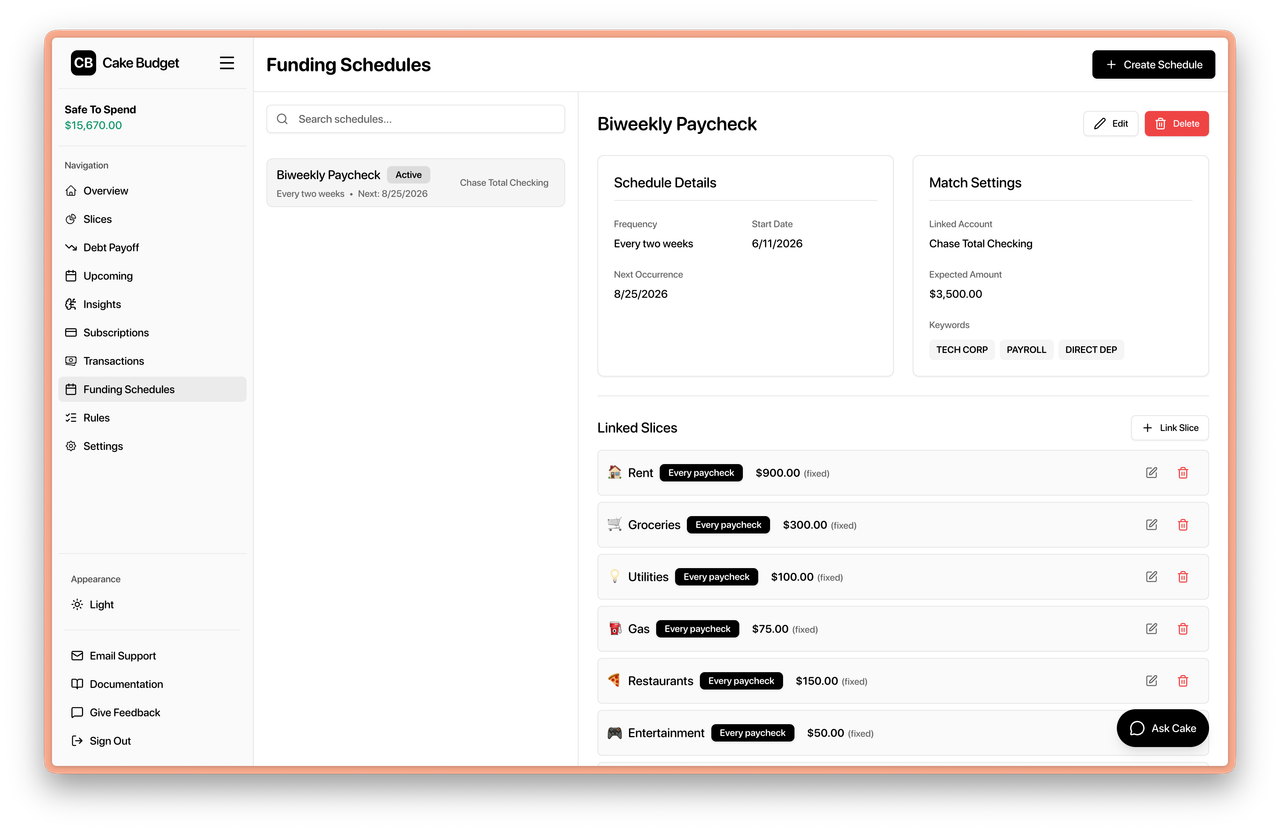
Budgeting by paycheck means you stop planning your money by month and start planning it by deposit: each specific paycheck gets its own list of bills to cover. Check #1 handles rent. Check #2 handles the car payment and insurance. Nothing is “budgeted for the month,” because your money doesn’t arrive by the month, it arrives every other Friday.
If you’ve ever been technically on budget and still had rent bounce because the money wasn’t there yet, this post is for you. I’ll cover the method itself, how to run it manually, where it breaks, and at the end, how my app automates it. That last section is a pitch, and I’ll label it.
Why monthly budgets quietly fail paycheck people
A monthly budget answers “can I afford $600 of groceries this month?” It never answers the question that actually hurts: “can I pay the rent that’s due on the 1st out of the paycheck that lands on the 25th?”
That’s a timing problem, not a math problem. Your bills don’t care about calendar months, they care about due dates. Your income doesn’t arrive in months, it arrives in paychecks. A monthly budget flattens both into a grid that balances on paper while your checking account tells a different story in the middle of the month.
The tell that you have a timing problem: your budget says you’re fine, but you still time bill payments around deposits in your head. That mental scheduling is budgeting by paycheck. You’re already doing it. The method just writes it down.
The method, manually
You need a sheet of paper or a spreadsheet, nothing else.
1. List your bills by due date, not category. Rent (1st), car insurance (7th), electric (12th), car payment (18th), and so on, down the month.
2. List your paychecks by arrival date. Paid biweekly? Map out the actual Fridays for the next couple of months, because they drift. Semi-monthly (15th and 30th)? Easier, but write them down anyway.
3. Assign every bill to the last paycheck that arrives before it’s due. Rent due the 1st gets funded by the paycheck around the 25th. The electric bill due the 12th comes out of the check on the 8th. Each paycheck now has a job list.
4. What’s left after each check’s jobs is that check’s spending money. Not the month’s. That check’s. This number is the whole point of the method: it’s what you can actually spend without touching something that’s spoken for.
5. On payday, move the money. Physically, into savings buckets, or on paper. The bills for that check are now funded, and what remains is genuinely yours until the next check.
Where the manual version breaks
I ran this on a spreadsheet for years, so I can tell you exactly where it cracks:
Three-paycheck months. Biweekly pay means two months a year have three checks. It’s a great problem, but your neat check-1/check-2 assignments don’t say what check #3 does, so it evaporates into normal spending.
Paychecks that land early. Payday shifts for a holiday, the deposit posts Wednesday night instead of Friday, and your careful mapping is suddenly off by a check.
The payday ritual itself. The method only works if you re-run it every single payday, forever. Miss two paydays because life happened, and the sheet is fiction. This is the same failure mode as every manual system: it depends on you showing up on schedule indefinitely.
If you’re disciplined about rituals, the spreadsheet version genuinely works, and you can stop reading here with my blessing.
The automated version (this is the pitch)
I built Cake Budget largely because of that third failure. Here’s how the method above maps onto it:
You create a funding schedule for each paycheck: this deposit, roughly this amount, on this cadence. When the paycheck lands, Cake recognizes it, even up to five days early, and splits it into your envelopes automatically. Rent gets $900 from every check, or the full amount from the first check of the month only. That per-check assignment is a first-class feature: first check funds rent, second check funds the car, and for biweekly folks, you decide what third checks do ahead of time instead of watching them vanish.
The result is the paycheck method with the ritual removed. Payday happens, the jobs happen, and what’s left shows up as one number: Safe to Spend. If you’ve got multiple jobs and multiple paychecks, each one gets its own schedule, which is its own topic entirely.
It’s $9 a month with a 14-day trial, no card required. If the spreadsheet version keeps breaking on you, it’s worth the trial period to feel a payday where you do nothing.
Common questions
Is budgeting by paycheck better than monthly budgeting? If your income arrives more often than monthly and your margin is thin, yes, because it solves timing, which is where thin budgets actually fail. If you have a comfortable buffer, monthly is simpler and works fine: the buffer absorbs the timing.
What do I do with three-paycheck months? Decide before the month arrives. Common answers: the whole third check goes to debt, to your emergency fund, or half and half. Any pre-decision beats no decision.
What if my paychecks are different sizes every time? Assign your bills to checks by percentage or priority order instead of fixed amounts, fund the essentials first, and treat the remainder as the variable part. Irregular income budgeting is its own method; we wrote about the gig-worker version here.
Can YNAB do this? You can approximate it manually each payday, and plenty of people do. What it lacks is the automatic per-paycheck assignment: you are the automation. Whether that ritual is grounding or a failure point depends on your brain; I wrote about that split here.
If payday-as-ritual keeps failing you, try the version that runs itself: 14 days free, no credit card, one paycheck schedule to set up.